Smith-Root is the world's leader in fish guidance and deterrence technology with over fifty electric fish barriers installed in North America and Europe over the last thirty years. Barriers range in scope from small systems in 1-meter diameter plastic culverts that protect lakes from carp invasions, to mid-sized stream barriers used to divert migrating species into hatcheries or traps for identification and sorting, to large-scale barrier systems that operate in the Chicago Sanitary and Ship Canal where they prevent invasive species from colonizing the Great Lakes, yet still allow the safe passage of commercial barge and pleasure craft.
We have the knowledge, experience, and technology to assist you in any fish barrier or behavioral guidance system application. We have systems to contain sterile grass carp within power-station cooling lakes, and barriers to prevent fish from moving upstream into hydropower tailraces. Fish species that have been successfully stopped or guided to another location include various trout and salmon species (cutthroat trout, rainbow trout, brown trout, Atlantic salmon, Pacific salmon), sea lamprey, round goby, Eurasian ruffe, common carp, Asian carp, grass carp, largemouth bass, golden shiners, gizzard shad, and numerous other local resident species. Evaluations of our barriers and guidance systems have confirmed that both juvenile and adult-sized fish can be successfully blocked or guided.
Newest Barrier Projects
__site-gallery.jpg)
__site-gallery.jpg)
What Does an Electric Barrier Do?
Each barrier/guidance system is designed and operated to change an animal’s behavior. While most of our systems have been installed to block fish movement totally, we have also installed systems where the objective is to guide fish towards a specific location (e.g., adult Pacific salmon across a stream towards the entrance to a fish ladder).
Electric barriers are used for control of invasive species, for clearing fish from turbine raceways and intakes, and for collecting runs to allow separating of fish species. They can also be calibrated to sort large fish from small. Since some species are less affected by electric fields, they can perform as filters.
Other unique applications have included:
- Containment of grass carp within a bay of a large, shallow reservoir
- Prevention of Pacific harbor seal predation on sockeye and other salmon captured in sampling gillnets
- Deterrence of Pacific harbor seals from establishing riverine feeding stations to prey on outmigrating Pacific salmon smolts
What Does A System Look Like?
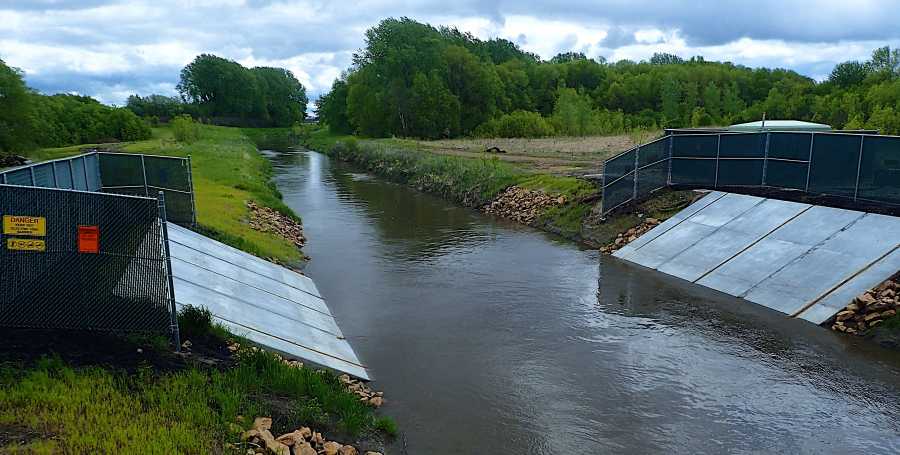
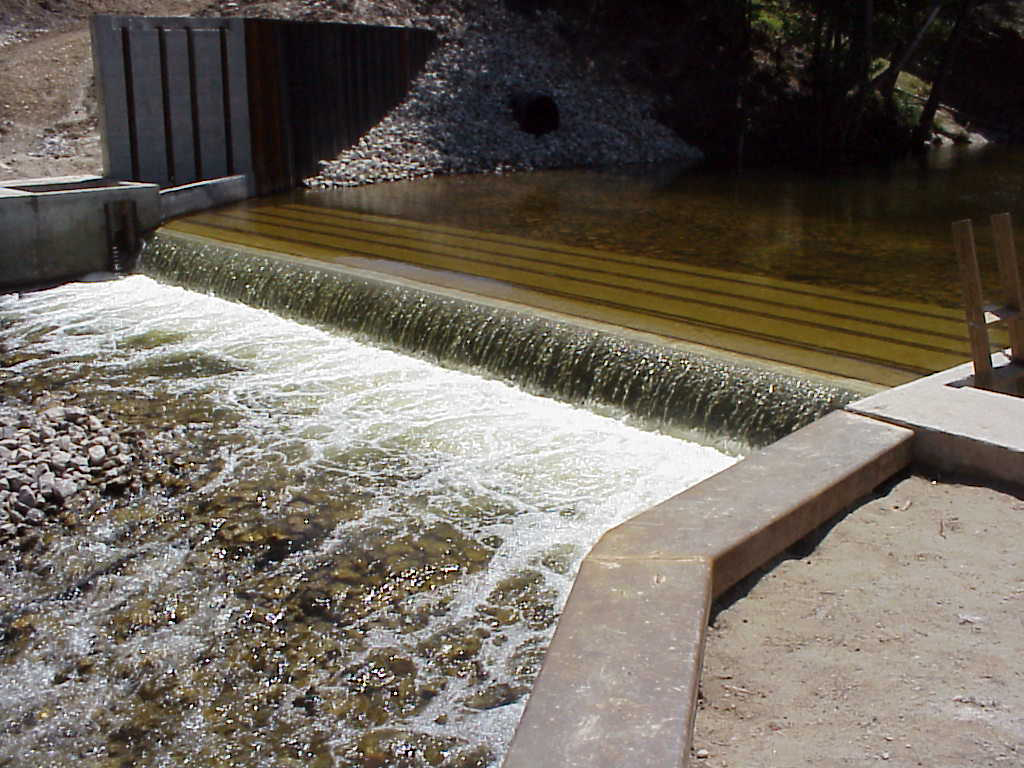
While each application is designed to achieve a specific barrier/guidance objective, a system generally consists of a series of electrodes (cables or metal bars) attached to the bottom of the channel, often in grooves in a concrete sill, rising up the sides of the channel to accommodate higher water levels. However there are many other types of configurations that our engineers can design, including vertical pile-mounted and suspended vertical electrodes. Different configurations produce different fields, some uniform, some graduated, some more intense close to the bottom.
A big advantage of an electric barrier or guidance system is that there need be no physical structure in the water column, as opposed to a screen, fence, or weir. Therefore, our barriers are not subject to debris clogging or physical damage and water traffic may pass unobstructed.
Each site is unique in terms of its channel geometry, electrical field characteristics, and overall objective. Smith-Root has the experience and technical staff to design and install a system that is suitable for your needs.
How Does Our System Work?
A typical barrier/guidance system produces a graduated, pulsed field of direct current (DC) in the water that affects muscular control in fish, or sensory organs (whiskers) in marine mammals. The animal feels uncomfortable in the field and moves in the direction that reduces the discomfort. The driving electric voltage comes from a Smith-Root pulser unit. A graduated field can be specifically designed to meet the needs of each site in terms of its physical configuration, water depth and conductivity, the size and species of fish for which behavior modifications are required to be changed, and the client’s objective (i.e., total blocking, guidance of adults, barrier to adults only, etc.).
Fields are mathematically modeled by Smith-Root to assist in their design and to provide a basis for calibration on site. Fields are represented as voltage gradients (V/cm). A fish within a field feels a voltage head-to-tail equal to the voltage gradient multiplied by the fish length. The total voltage from one end of the field to the other is not relevant to fish behavior.
While barriers to upstream-migrating fish can be set high to disable temporarily any fish that challenge them (since disabled fish will be swept downstream), barriers to downstream-migrating fish have to be designed carefully to balance the electrical field and the water velocity patterns so that fish are repelled before they become disoriented.
Typical Electric Fish Barrier
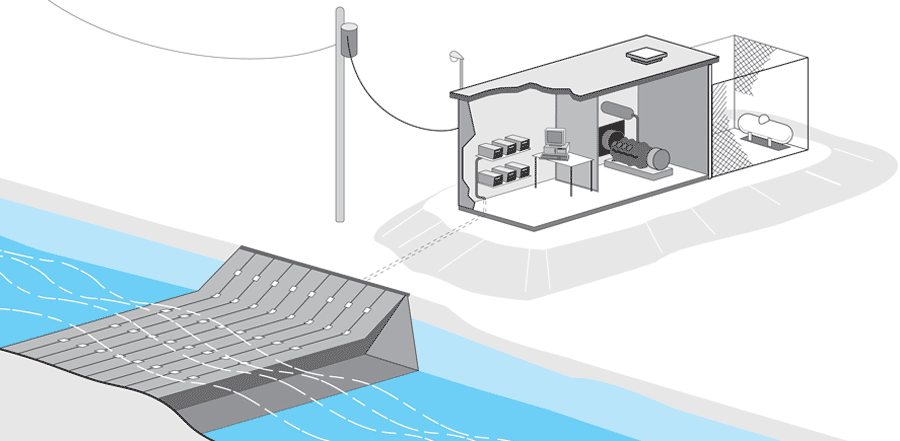
This illustration shows a typical large stream electric fish barrier system installation. The example system includes standard BP-1.5 Programmable Output Waveform (POW) pulsers. The pulsers are connected to a group of electrodes submerged in the waterway. The pulsers store energy in a large capacitor bank and then quickly discharge the energy through the water. Pulse width and repetition are adjustable to create the waveform required to halt the movement of fish. The number of pulsers required in a barrier system depends on several factors and will be determined by Smith-Root during the project evaluation phase. All Smith-Root barrier systems include our custom-developed Fish Barrier Telemetry & Control System (FBTCS) for system setup and monitoring.
BP-1.5 POW Pulser
The BP-1.5 POW is our most popular pulser and outputs up to 1.5 kilowatts. Pulsed waveforms and frequencies can be programmed for optimum fish blocking or repelling. The BP-1.5 POW can produce a wide range of DC pulse outputs to give more stopping power while causing less stress to fish. Pulsers with larger output capacities can be custom designed to meet the needs of your project.
Each BP-1.5 pulser includes a microprocessor to control width, frequency, and period of the output. A variety of waveforms can be generated: standard pulses, sweeping pulse widths, sweeping frequencies, and gated bursts. This allows generation of optimum waveforms that are effective with a wide range of species. Use of the FBTCS software is required to setup, monitor, and control the pulsers.
Fish Barrier Telemetry and Control System (FBTCS)
Smith-Root fish barrier installations are monitored and controlled by the Fish Barrier Telemetry & Control System (FBTCS). The FBTCS is an advanced graphical interface computer application that provides the following features:
- 24x7 Barrier site monitoring
- Complete remote control and monitoring via network or modem
- Pulser output waveform control
- Pulser and relay control based on current water level
- Automatic detection of all Smith-Root devices connected to the network
- Alarm condition monitoring and email alarm reports
- Event logging with search and filtering
- Building security monitoring and control
Barrier Safety
There are two areas of concern for electrical safety. Out of the water, the Smith-Root electrical barrier systems are designed with careful attention to all national safety codes. Nevertheless, we require barriers to be fenced and warning signs also be posted. In the water, the water acts as a conductor in the circuit. The voltage is dissipated over the length of the field so that the voltage gradient over any small length of the field is much less than the total voltage applied.
Smith-Root barrier and behavioral guidance systems are designed to be non-lethal and to use only low-frequency pulsed direct current (DC) to create electric fields. Humans are three times more likely to be harmed by alternating current (AC) than by DC current, and it has been shown repeatedly in the scientific literature that use of AC can injure fish. Pulse frequency (especially) and duration and current can all contribute to potential damage, thus Smith-Root typically sets these values well below the electrocution threshold of a typical ground fault interrupter. Pulse frequencies for barriers are much lower than those used in traditional electrofishing. Our interest for most barriers is in changing fish behavior, not achieving galvanotaxis, tetany or anesthesia.
Vessels can safely pass through our electrical fields. Metal-hulled vessels create local short-circuits (requiring longer fields to ensure that fish do not find a pathway through); there are no potential differences within a hull. Hulls of insulating materials merely distort the field by displacing the conductive water. As occurs in the Chicago Sanitary and Ship Canal multiple times per hour, metal-hulled barges traverse our series of electric barriers for Asian carp control with no effects to vessels or occupants. Smith- Root systems are safe to operate when done so in accordance with the design criteria specified for each unique situation.
Meet Our Team
Smith-Root has a team of scientists, electrical engineers, and civil/structural engineers available to help you through the entire decision making process. We can help define your biological objectives, suggest what type of physical structure and configuration might best accomplish your objective, and provide the appropriate electronic equipment to generate the field you need.

Brandon Byrne, Paralegal, CSSBB
Contract Administrator/Project Manager